
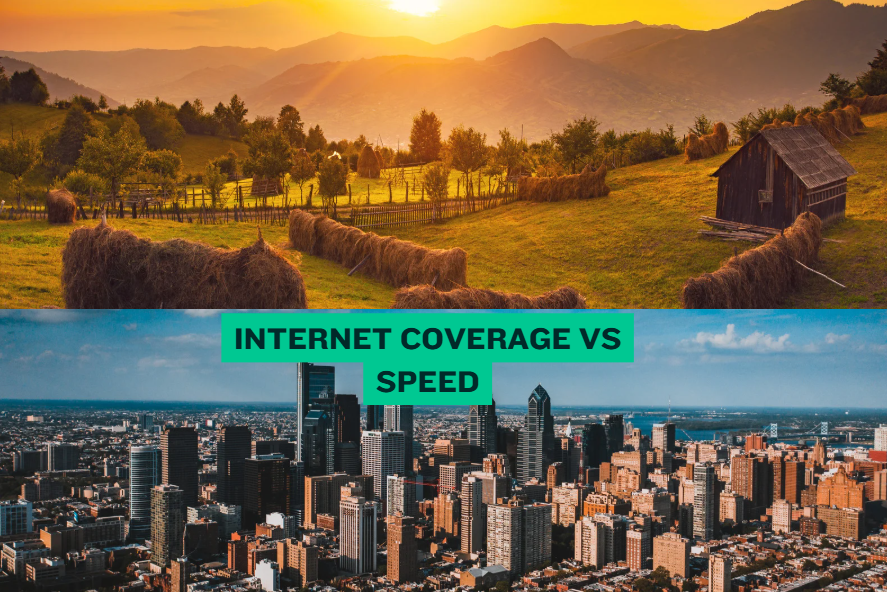
When I first tried using an eSIM while traveling across the USA, I thought one plan would cover everything.
But soon I realized something important: coverage and speed are not the same thing.
You might have signal bars, but your internet speed could still crawl like a snail. And if you are in a rural town, the story is very different from being in a busy city.
Let’s explore this together so you can make the best choice for your eSIM, whether you’re staying in New York City or driving through the small towns of Wyoming.
Why Coverage and Speed Are Two Different Things
Coverage is like having a road. Speed is how fast you can drive on it. In some parts of the USA, you’ll see good coverage bars, but your data speed will still feel slow because the network is crowded or the towers are older.
In cities, carriers usually build strong networks with 5G towers, so the speed feels fast.
In rural areas, you may only get LTE, and sometimes even that drops to 3G or no service at all.
So, when picking the best eSIM in the USA, you must check both coverage maps and real-world speed.
USA eSIM Coverage Map: What It Really Tells You
Every carrier shows a colorful map with lots of purple, blue, or green areas that look like full coverage. But here’s the truth—coverage maps show potential service, not guaranteed speed.
For example, AT&T might cover a small farm town in Kansas on their map, but in reality, you could barely load Google Maps. On the other hand, T-Mobile might show less coverage in some states but offer strong 5G where they do cover.
When checking an eSIM provider, I always compare the coverage map with local reviews. Travelers post speed tests online, and that’s often more honest than marketing maps.
Rural vs Urban Internet Speed in the USA

In big cities like Los Angeles or Chicago, you’ll find blazing-fast 5G. Streaming, gaming, and video calls are smooth.
But go just 20 miles outside into small towns, and speeds can drop sharply.
This happens because rural areas don’t have as many towers. Fewer towers mean weaker signals and slower data.
Sometimes you’ll still connect, but the latency (the delay in loading) is high. That’s a big problem for video calls or maps that need quick updates.
So, if you plan to travel across rural America, your focus should be coverage first, speed second.
Best eSIM for Rural Areas in the USA
From my trips through small towns and countryside roads, I noticed some providers do better in rural America.
AT&T-based eSIM: Strong coverage in rural areas, especially in the Midwest and South. LTE is reliable even if 5G isn’t always there.
Verizon-based eSIM: Very good for countryside travel, with fewer coverage gaps than others. Speeds can be average, but the signal rarely drops.
T-Mobile-based eSIM: Not as strong in remote regions, but improving. Better if your rural trip is closer to highways and larger towns.
If you’re picking an eSIM for farming towns, mountain cabins, or national parks, always check reviews for that exact region. A plan that works in Montana may not perform the same in rural Texas.
Best eSIMs for Urban Areas in the USA
For cities, the story flips. Here, T-Mobile often shines with its wide 5G network.
AT&T and Verizon are also reliable, but in many city areas, speed differences are small.
The competition is so high that all major carriers try to keep speeds fast.
If you’re living or traveling mostly in big cities, pick a provider with:
- Strong 5G coverage
- Large data limits
- Support for high-speed streaming and tethering
Urban travelers should focus more on speed and data caps rather than coverage gaps, because you’ll likely be surrounded by towers anyway.
LTE vs 5G Speed in the USA
I’ve tested both LTE and 5G in different states. In cities, 5G often feels 10 times faster than LTE. Downloads finish quickly, and videos load instantly.
In rural zones, LTE is still the backbone. 5G towers haven’t reached every corner yet.
So, when picking an eSIM plan, check if it offers good LTE fallback. You don’t want a provider that only shines in cities but leaves you struggling in rural areas.
Coverage Gaps That Travelers Should Know
One thing that surprised me was the amount of “dead zones” still left in the USA.
Some national parks, desert areas, and mountain ranges have almost no signal. It doesn’t matter which provider you choose—sometimes, there’s just no coverage.
If you’re traveling through these areas, consider downloading offline maps and music. Your eSIM plan won’t save you if no tower exists nearby.
eSIM Performance in Countryside vs Cities
In the countryside, signal strength is like fishing—sometimes you catch a big one, sometimes nothing bites. In cities, it’s more like a buffet, always plenty of options.
From personal experience, I felt more comfortable with Verizon or AT&T when going rural, but I loved using T-Mobile when exploring cities. If you mix both trips, a global eSIM that connects to multiple networks might be your best friend.
Data Speed Tests: What Numbers Say
In New York City, I saw eSIM speeds of over 400 Mbps on 5G. In small towns in Oklahoma, it dropped to 15 Mbps on LTE. That’s still enough for browsing and maps, but video calls struggled.
Numbers change a lot, so always test your connection with apps like Speedtest. Real numbers speak louder than coverage promises.
Tips for Choosing the Right eSIM for USA Travel
Look at coverage first if you’ll be in rural areas.
Focus on speed and data limits if you’ll stay in cities.
Choose providers that allow easy switching between networks.
Always check reviews from locals or travelers in your exact location.
Finally
Picking the right eSIM in the USA is not just about speed—it’s about where you’ll be using it. Cities give you strong 5G and fast internet. Rural areas need strong LTE coverage and patience with slower speeds.